Customer Hotline:
+1 6193853151
 Customer Hotline:
+1 6193853151

Product catalog
Related articles
Detailed Introduction
Antigen Name:
Human ErbB3 / Her3 Protein,His Tag
Other Names:
ERBB3, HER3, LCCS2, MDA-BF-1, MGC88033, c-erbB3, erbB3-S, p180-ErbB3, p45-sErbB3, p85-sErbB3;
background:
ErbB3, also known as Her3 (human epidermal growth factor receptor 3), is a member of the epidermal growth factor receptor (EGFR) family of receptor tyrosine kinases. This membrane-bound glycoprotein has a neuroligin binding domain but no active kinase domain. Therefore, it can bind to ligands but cannot mediate intracellular signal transduction through protein phosphorylation . However, it can form heterodimers with ErbB2 or other epidermal growth factor receptor members, responsible for tyrosine phosphorylation, thereby forming a receptor complex and initiating related pathways, leading to cell proliferation or differentiation. This protein has been reported to be overexpressed in a variety of cancers, including prostate cancer, bladder cancer, and breast cancer. This protein has different isoforms, which come from different splicing variants, among which the secreted isoform lacking the intermembrane region can regulate the activity of the membrane-bound type.
Sequence source:
Human ErbB3 / Her3 Protein, His Tag is expressed by Chinese hamster ovary (CHO) cells; the protein number is P21860-1 (Ser20-Thr643-), with His tag;
Molecular Weight:
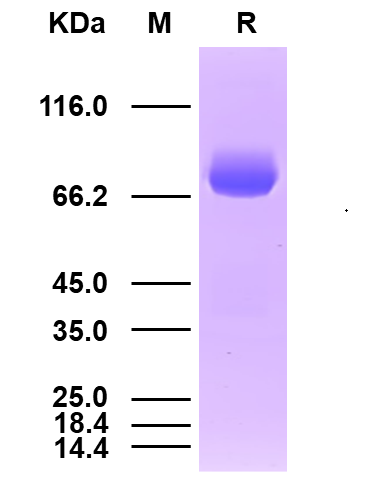
The theoretical molecular weight is 70.5 kDa. Due to glycosylation, the molecular weight of SDS-PAGE reduction electrophoresis is 70 kDa and 80 kDa.
Specifications:
|
Catalog Number |
Specification |
|
QRE-174 |
100 μg |
If you need large packages, please contact customer service at 0512-87663137, or send an email to sales@rhinobio.com.
purity:
SDS-PAGE electrophoresis purity>95%;
application:
Monoclonal antibody used for quantitative detection of HumanErbB3 / Her3 Protein, His Tag in cell culture medium, serum and milk.
concentration:
1mg/ml;
Buffer:
20mM PB0.15M NaClpH7.4;
Storage conditions:
This product can be stored at -70℃ for 36 months; at -20℃ for 12 months; at 2-8℃ for 1 month. Please avoid repeated freezing and thawing.