Customer Hotline:
+1 6193853151
 Customer Hotline:
+1 6193853151

Product catalog
Related articles
Detailed Introduction
Protein kinases are one of the most important classes in drug discovery. They play a vital role in the regulation of a variety of cellular events. At least 1,200 protein kinases are known to be involved in the regulation of cellular functions. Kinases exist as both transmembrane and cytoplasmic enzymes. They phosphorylate serine, threonine, and tyrosine amino acid residues. Based on these substrate specificities, kinases are divided into two groups, serine/threonine kinases and tyrosine kinases.
Kinases exert their effects by phosphorylating their respective downstream specific substrate proteins. They catalyze the transfer of γ-phosphate of ATP or GTP to the hydroxyl groups of serine, threonine and tyrosine in substrate proteins or to the glycosyl moieties in lipids and initiate a series of activation-controlled events, including cell growth, differentiation, division and tumor promotion. The lack of controlled activity of kinases in cells is believed to be the cause of all major human pathological conditions, such as cancer, cardiovascular disease, neurodegenerative diseases and metabolic disorders, and therefore it has been widely studied as a target for tumor therapy.
Overview:
The Kinase-Turbo™ Kinase Activity Assay Kit is a kit that uses chemiluminescence to determine the amount of ATP remaining in the solution after the kinase reaction, thereby quantitatively detecting the activity of the kinase. During the reaction, the kinase catalyzes the transfer of the phosphate group on ATP to the hydroxyl group of the substrate, thereby converting ATP into ADP, and the activity of the kinase is quantified based on the amount of ATP reduction (as shown in Figure 1). This kit uses the luciferin luminescence reaction catalyzed by ATP-dependent luciferase to determine the intracellular ATP content through chemiluminescence signals. In this way, the amount of ATP in the kinase reaction system can be quantified by setting a standard curve of ATP, thereby calculating the amount of ATP reduction and ultimately calculating the activity of the kinase. The activity of the kinase is inversely proportional to the amount of ATP remaining, that is, the less the amount of ATP remaining, the lower the luminescence value , and the higher the kinase activity ; if the amount of ATP remaining is more, the higher the luminescence value , the lower the kinase activity.
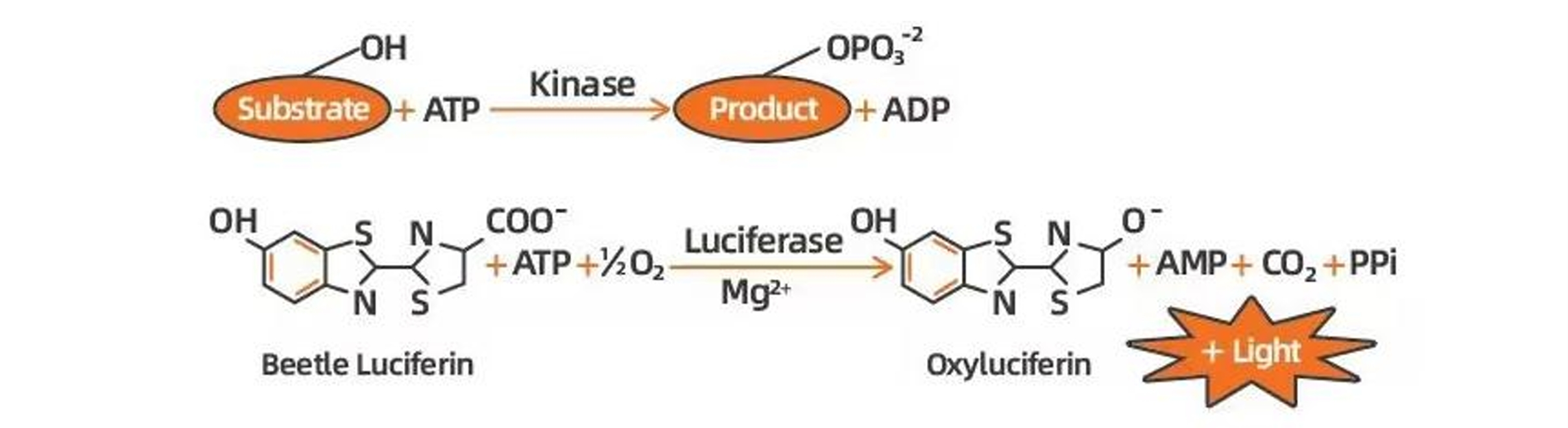
Figure 1. Detection principle diagram
The Kinase-Turbo™ Kinase Activity Assay Kit (Cat. No.: RA-GL13) can be used with a maximum ATP concentration of 10 μM, and has good linearity in the range of 0-10 μM (as shown in Figure 2); the Kinase-Turbo™ Plus Kinase Activity Assay Kit (Cat. No.: RA-GL14) can be used with a maximum ATP concentration of 100 μM, and has good linearity in the range of 2-100 μM (as shown in Figure 3); the Kinase-Turbo™ Max Kinase Activity Assay Kit (Cat. No.: RA-GL15) can be used with a maximum ATP concentration of 500 μM, and has good linearity in the range of 3-500 μM (as shown in Figure 4).

Figure 2. Linearity at ATP concentration of 10 μM (Cat. No.: RA-GL13)

Figure 3. Linearity at ATP concentration of 100 μM (Cat. No.: RA-GL14)

Figure 4. Linearity at ATP concentration of 500 μM (Cat. No.: RA-GL15)
application:
It can be used to detect the kinase activity of substances such as proteins, lipids and sugars , and is suitable for the combined detection of multiple kinases and kinase substrates.
Reagent packaging:
|
Reagent name |
Part Number |
Specification |
|
Kinase-Turbo™ Kinase Activity Assay Reagent |
RA-GL13-A |
10ml |
|
RA-GL13-B |
10×10ml |
Product Features:
1. A higher ATP concentration can be used: the
linear response is up to 500μM ATP;
2. A variety of kinases and kinase substrate combinations can be detected,
including peptides, proteins, lipids and sugar substrates ;
3. The analysis can be performed directly without processing the substrate; 4.
Batch processing, highly stable luminescent signal, can still maintain more
than 50% of the signal for about 3 hours; 5. Known kinase inhibitors can be
detected, and ATP-competitive and ATP-non-competitive kinase inhibitors can be
distinguished; 6. This rapid, uniform, and non-radioactive detection method can
be used to screen a large number of library compounds.
Storage conditions:
Store at -70℃. Return the reagent to room temperature before use and use at room temperature after reconstitution. To ensure product stability, use the reconstituted reagent immediately. Avoid repeated freezing and thawing of the reagent.