Customer Hotline:
+1 6193853151
 Customer Hotline:
+1 6193853151

Product catalog
Related articles
Detailed Introduction
background:
Mycoplasma is a general term for prokaryotic microorganisms of the Mycoplasma, Acholystaceae and Spiroplasma families . It is the smallest known free-living organism with no cell wall, variable shapes, and a diameter of 0.1 to 0.3 μm. It has a high AT content in the genome, is insensitive to common antibiotics, and is sensitive to heat. At present, about 200 species of mycoplasmas have been found in sewage, plants, animals, poultry, insects, humans, hot springs or other high-temperature environments.
If cells are contaminated with mycoplasma, the cell growth rate slows down, and the cells develop lesions or morphological changes. The probability of continuous culture cell contamination is about 15-35%, mainly from more than 20 mycoplasmas, including oral mycoplasma ( M.orale ), pneumonia mycoplasma ( M. pneumoniae ), fermentation mycoplasma ( M. fermentans ), arginine mycoplasma ( M. arginini ) , laidlawii ( A. laidlawii ) and hyorhinis mycoplasma ( M. hyorhinis ).
Human operations, contaminated cells, raw materials and auxiliary materials (serum, trypsin, culture medium), experimental environment pollution (biosafety cabinets, cell rooms, incubators), experimental instruments (water baths, liquid nitrogen tanks), and experimental consumables (culture dishes, square bottles, cell factories) may all be sources of contamination. On the one hand, contaminated cells have a huge impact on production. On the other hand, if cell products, protein products, and viral products are contaminated with mycoplasma, they will eventually bring potential health risks to patients. Therefore, regulatory authorities require companies to conduct mycoplasma testing on cell banks, test cells, and products, control them from the source, detect them as early as possible, and ensure that released products do not contain mycoplasma. In response to this, drug regulatory authorities in countries around the world have also issued relevant guidelines for mycoplasma testing. The detection methods mainly include fluorescent staining, culture, nucleic acid amplification, and biochemical detection methods.
Overview:
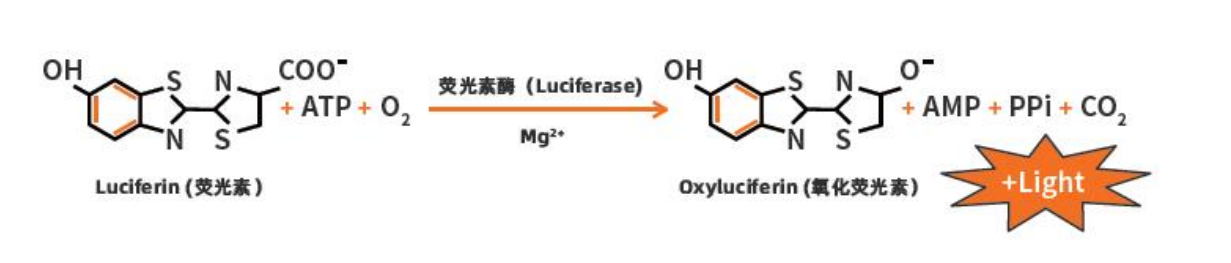
Rhinogen ® MycoAlarm ™ Mycoplasma Detection Kit uses a biochemical method for mycoplasma detection. It uses the ATP synthesis-related enzymes unique to mycoplasmas to convert ADP into ATP in the presence of substrates. After the surviving mycoplasmas are dissolved, a large amount of enzymes are released to react with the substrates, promoting the conversion of ADP into ATP, providing a fast and sensitive sample detection method. By comparing the changes in the ATP content of the sample after adding the substrate, the presence or absence of mycoplasma can be determined by the ratio of the content changes before and after. The reaction is as follows:
Reagent packaging:
Rhinogen ® The MycoAlarm ™ Mycoplasma Detection Kit packaging specifications are as follows:
RA-MT01 Specifications:
|
Reagent components |
Part Number |
Specification |
||
|
25T |
50T |
100T |
||
|
MycoAlarm ™ Assays (lyophilized powder) |
RA-MT01A |
1×1.5ml |
1×3ml |
2×3ml |
|
MycoAlarm ™ Substrate Reagents (lyophilized powder) |
RA-MT01B |
1×1.5ml |
1×3ml |
2×3ml |
|
MycoAlarm ™ Assay Buffer |
RA-MT01C |
1×4ml |
1×8ml |
2×8ml |
RA-MT02 Specifications:
|
Reagent components |
Part Number |
Specification |
|
MycoAlarm ™ Positive Control (lyophilized powder) |
RA-MT02A |
1×1.2 ml |
|
MycoAlarm ™ Positive Control Diluent |
RA-MT02B |
2×1.5 ml |
Product Features:
1. Simple operation: It only takes 20 minutes to detect whether there is mycoplasma contamination in cell culture;
2. High specificity: no interference from bacteria, fungi, and yeast;
3. High luminescence value : compatible with a variety of luminescence readers or multi-function microplate readers.
Storage conditions:
Ice pack transportation, after receiving the goods:
1) Store
the RA-MT01 kit at 2~8℃. Do not freeze it. Take out the kit and restore it to room
temperature (20-22℃ is best). After reconstitution,
take the required volume for use.
2) Store the RA-MT02 kit at -70℃ for long-term storage
or -20℃ for short-term storage. It is recommended to
divide the unused part of the reagent according to the amount to avoid repeated
freezing and thawing of the reagent. Please restore the reagent to room
temperature (20-22℃ is best) before use.
3) After reconstitution, store the reagent at -70℃. It
is recommended to use it within 3 months.