Customer Hotline:
+1 6193853151
 Customer Hotline:
+1 6193853151

Product catalog
Related articles
Detailed Introduction
background:
O - Glycoprotease is recombinantly expressed in E. coli with a 6×His tag at the C- terminus . O - Glycoprotease is an O -glycoprotein-specific endoprotease that catalyzes the hydrolysis of peptide bonds directly adjacent to the O-polymer in native mucin- type O - glycosylated proteins .
O- Glycoproteinases act as endoproteases and digest proteins at the N-terminus of O- glycans at serine or threonine with high specificity. This generates glycopeptides carrying O- glycans at the N-terminus and enables O -glycan analysis, O - glycan localization , and O -glycan site determination.
O- Glycoproteinase is most active against sialylated core 1 O- glycans, less active against core 3 O- glycosylated and α 2,3 sialylated core 1 glycoproteins, and inactive against Tn antigen, core 2, and α 2,6 sialylated core 1 O- glycan sites. The enzyme does not cleave when only N-glycans are modified . The enzyme is active against O- glycans with or without sialic acid , and is more active on desialylated O- glycans. The enzyme maintains high activity between pH 5.5-7.5, is resistant to 1M NaCl, but is highly sensitive to EDTA (0.5mM EDTA), and is partially inhibited by Zn 2+ .
Product Packaging:
Rhinogen ® O -Glycoprotease ( O - Glycoprotease ) packaging specifications are as follows:
|
Catalog Number |
Specification |
preparation |
|
QIP-008 |
2000U |
Lyophilized in 20 mM TBS, pH 7.6, no preservatives added |
Supporting reagents:
Rhinogen ® α2-3,6,8,9 Neuraminidase (EDTA-free) provided are as follows:
|
Catalog Number |
Specification |
preparation |
|
QPF-012 |
0.6U/30μl |
50mM NaCl, 20mM Tris-HCl (pH7.5 at 25°C) |
The reagents provided are as follows:
|
Catalog Number |
Reagents |
Element |
|
EB10 |
10× Glyco Buffer 3 |
200 mM Tris, pH 6.8 |
Product Source:
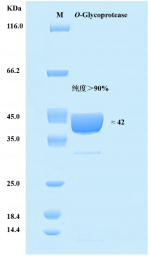
Rhinogen ® O -glycoproteinase is recombinantly expressed in E. coli, with a theoretical molecular weight of approximately 42KD and a 6×His tag at the C- terminus .
Product quality:
1. High stability: Each batch of products undergoes strict quality control to achieve batch-to-batch stability ;
2. High purity: detected by SDS-PAGE, the purity of O -glycoproteinase is ≥90%, and the purity of α2-3,6,8,9 Neuraminidase is ≥95%.
Product Features:
O - Glycoprotease is an O - glycoprotein-specific endoprotease that catalyzes the hydrolysis of peptide bonds directly adjacent to the O -polymer in native mucin -type O -glycosylated proteins , at the N-terminus of O -glycosylated serine and threonine residues.
Enzyme activity definition :
When used in combination with α2-3,6,8,9 Neuraminidase (EDTA-free), incubated at 37°C for 2 hours in 20 mM Tris-HCl, pH 6.8, 1 unit of enzyme (1U) can digest ≥90% of 1 μg of glycoprotein (TNFR), as confirmed by SDS-PAGE.
Storage conditions:
Transport with ice packs. For long-term storage, place at -20℃. After resuspending, store at 2-8℃ for 1 month. Avoid repeated freezing and thawing.
application:
1. O -glycosylation analysis;
2. O -glycan profile;
3. O -glycan site determination.
Frequently asked questions
Q1: What are the known inhibitors of
O-glycoproteinase?
A1: O-glycoproteinase is a metalloproteinase and is therefore highly sensitive
to chelating agents such as EDTA, with concentrations >5mM resulting in
complete inhibition of the enzyme. ZnCl2 also partially inhibits
O-glycoproteinase activity.
Q2: Can O-glycoproteinase be used in combination with sialidase?
A2: Yes, in combination with sialidase, it can be used to desialylate and
digest O-glycosylated proteins, improving the efficiency of O-glycoproteinase
cleavage .
Q3: Is it necessary to remove sialic acid?
A3: The activity of O-glycoproteinase is significantly reduced in the presence
of sialic acid, so we recommend using sialidase to remove sialic acid. Or try
digesting your sample with and without sialidase to evaluate whether sialic
acid removal is necessary for your specific sample.
Q4: Does the sample need to be in its native folded state? Or does it need
to be denatured?
A4: If digestion is insufficient, it may be due to steric hindrance in the
O-glycans of the sample, which the enzyme cannot reach. In this case, we
recommend trying the following workflow: reduction, denaturation,
carboxymethylation, buffer exchange, and then digestion with O-glycoproteinase
and sialidase.